Introduction:
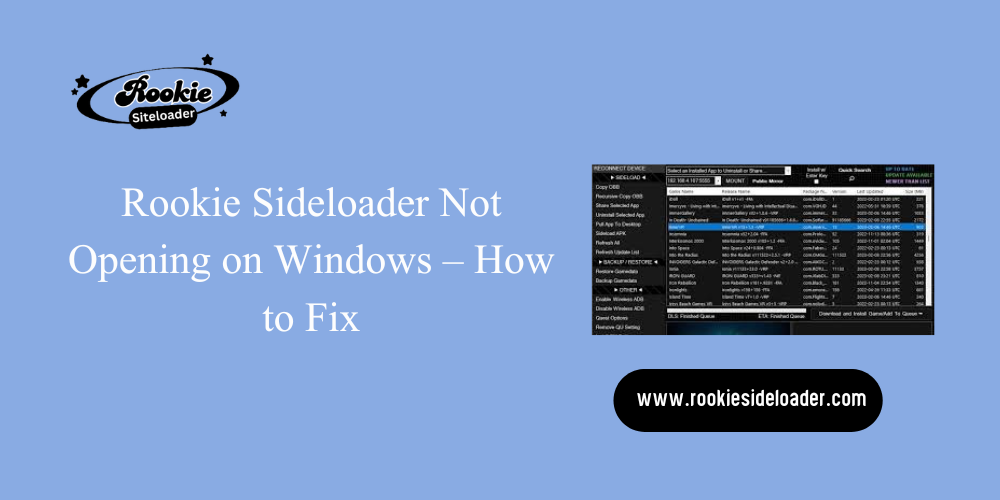
For users diving into virtual reality and custom software, tools like Rookie Sideloader are indispensable for sideloading applications onto compatible devices. This process, which bypasses traditional app stores, relies heavily on the stability and configuration of your host PC. When users report that their sideloading software won’t open on Windows, it signals a critical friction point.
This installation failure can present quietly, sometimes as a brief flash on the screen, other times as total silence, leaving users unable to proceed with their setup. Addressing this requires a systematic approach to Windows troubleshooting, focusing on the underlying security and system conflicts that often prevent low-level utilities from running correctly. Understanding these core issues is the first step toward a successful sideload APK error fix.
Why Sideloading Software Won’t Launch
Before initiating any corrective steps, it is vital to correctly diagnose the reason the application is failing to launch. The silent failure of an executable file is almost always traced back to one of three categories:
- Permissions Issues: The application is blocked from running because it lacks the necessary administrative rights to access or modify system resources and crucial directories. This is a common hurdle for utilities that interact with device drivers and external hardware.
- Antivirus Interference: Proactive security software misidentifies the application’s file manipulation or network activity as malicious, leading to the program being quarantined or its execution being forcefully blocked (security software blocking).
- Missing Dependencies: The Windows operating system is missing essential foundational components, like specific frameworks or libraries, that the application relies on to execute its code (dependency errors).
Resolving Permissions and Execution Issues
Permissions are the most frequent and often the simplest problem to fix. Sideloading utilities require elevated rights because they must communicate directly with hardware and drivers, functions that Windows restricts for standard user accounts.
Execute with Elevated Privileges: Run as Administrator
Locate the primary executable file or the shortcut for the sideloading application. The quickest fix is to right-click the file and select Run as administrator. This action grants the necessary system-level access to the application, often resolving the immediate launch problem by allowing it to read and write data in critical directories.
For a permanent solution, set the shortcut’s properties to always run as administrator on the Compatibility tab. Failing to use this function is a significant source of permissions issues.
Inspect and Adjust Installation Directory
Windows applies strict security protocols to specific directories. If the program was installed in a secure protected system folder, such as C:\Program Files or Program Files (x86), the system may prevent it from running correctly. If the program fails repeatedly, try reinstalling it to a more straightforward, less-protected path, such as C:\Tools\Rookie or a dedicated folder at the root of a non-system drive. This bypasses potential folder-level restrictions.
Verify User Account Control (UAC) Settings
While less common, stringent User Account Control (UAC) settings can interfere with the sideloading tool’s operation. If you have customized UAC settings to a very high level, consider temporarily lowering the notification threshold to see if the application launches. Always restore UAC to recommended settings afterward for optimal system security.
Grant Full Control via Security Properties
For deep-seated permissions issues, you may need to manually verify and adjust NTFS permissions. Right-click the installation folder, select Properties, select the Security tab, and ensure your current Windows user account has Full Control over all files and subfolders in the installation directory. This addresses particular conflicts where the application might be blocked from writing temporary files.

Addressing Antivirus and Firewall Interference
Security software often employs heuristic analysis, flagging any program that attempts to manipulate other applications or drivers a key function of a sideloading utility. This interference can appear identical to a silent launch failure.
Temporary Disablement and Diagnosis
Before troubleshooting further, temporarily disable your installed Antivirus program (including Windows Defender’s Real-Time Protection). Attempt to launch the program. If the sideloading program launches successfully, the Antivirus is undeniably the root cause, confirming that security software is blocking it.
Creating a Permanent Exclusion
If the Antivirus is the culprit, you must not leave it disabled. Re-enable the Antivirus and navigate to its settings menu (often labeled ‘Exclusions,’ ‘Whitelisting,’ or ‘Allowed Threats’). Add the full path to the folder where the sideloading tool is installed as a permanent exception or exclusion.
This ensures the Antivirus will ignore the specific files in that directory, preventing future conflicts without compromising overall system security.
Check Network Access (Windows Firewall)
Even if the program launches locally, network communication can be blocked. Windows Firewall might be silently blocking the application from communicating with external servers or with your VR device over the network. Open Windows Defender Firewall settings and ensure the sideloading application is listed as an allowed app for both the Private and Public network profiles. If prompted upon launching the tool, always allow access to prevent network communication-related installation failures.
Installing Missing Runtime Dependencies
A failure to launch with no error message is the classic sign of missing runtime dependencies. The application is ready to run its code, but finds a crucial software dependency missing from the operating system, resulting in an immediate, silent exit.
Microsoft Visual C++ Redistributable Packages
This is the most frequent cause of a silent Windows troubleshooting problem. Windows applications often rely on shared libraries provided by these packages. You must ensure you have the correct versions installed.
Download and install both the x86 and x64 versions directly from the official Microsoft website. Installing these foundational libraries is often the immediate solution to an APK parsing error or a silent crash.
DirectX and .NET Framework Updates
Ensure your system has the latest necessary version of the .NET Framework. Many sideloading tools are built on this framework. Run the Windows Update utility to confirm all optional and critical framework updates have been applied. Additionally, while primarily for games, ensuring your DirectX installation is up to date can also resolve underlying system library issues that cause dependency errors.
Verify Operating System Updates
An outdated Windows OS may lack crucial security patches or updated library files required by modern applications. Regularly running Windows Update is an essential part of Windows troubleshooting that helps maintain system compatibility and prevent future installation failures.
Precautions to Avoid Future Launch Failures
- Trusted Sources: Always download installation files from trusted sources to mitigate the risk of corrupted files or malicious code that your antivirus might rightfully block.
- Administrative Privilege: Make it a habit to always run the application’s executable file or the installer with the Run as administrator option.
- Full System Updates: Keep the Windows OS fully up to date and ensure all Microsoft Visual C++ and .NET Framework updates are installed.
- Post-Install Check: After installation, immediately create the necessary antivirus exclusions before the security software has a chance to quarantine essential files.
Frequently Asked Questions
What does it mean when a program is “not opening on Windows” silently?
A silent launch failure, where no error message or window appears, typically indicates a severe, immediate failure. This is most often caused by a missing software dependency (such as a Visual C++ library) or by aggressive security software that blocks the program’s execution before it can initialize.
Why do I need to “Run as administrator” for this type of tool?
Tools used for sideloading must communicate directly with device drivers and write data to restricted system folders, particularly when installing files onto a connected external device. Elevated permissions issues are required for this low-level interaction, which the standard user account lacks.
How can I check if my Antivirus is causing the installation failure?
To check for security software blocking, temporarily disable your Antivirus or Windows Defender (Real-Time Protection). If the program launches while security software is disabled, you must immediately re-enable the security software and create a permanent exclusion for the application’s installation folder to prevent the installation from failing.
What are the common runtime dependencies I might be missing that cause this error?
The most frequent missing runtime dependencies are the various versions of the Microsoft Visual C++ Redistributable packages. Installing the latest versions (both x86 and x64) from Microsoft’s website is the primary fix for this type of dependency error.
Does the “Rookie Sideloader not opening on Windows” error mean the download was corrupted?
While a corrupted file is one possible cause, a silent launch failure is more often related to a missing software dependency, a permissions conflict, or an antivirus block. File corruption is more likely to result in a dedicated error message during the installation process itself, rather than a silent failure to launch.
Can simply restarting my PC solve the “sideloading software not opening” problem?
A simple restart can often resolve temporary system resource conflicts or stuck processes, making it a valuable first step in Windows troubleshooting. However, it will not fix missing .NET Framework libraries or correct antivirus exclusions.
Is the error related to the .NET Framework or DirectX?
Yes, many sideloading tools rely heavily on the .NET Framework for their interface and functionality. An outdated or incomplete .NET installation is a common source of dependency errors. Ensure your Windows operating system is fully updated to resolve these framework issues.
What is the best directory path to install the tool to avoid permissions issues?
To avoid potential permissions issues, the best practice is to install the tool in a simple, non-protected directory, such as a custom folder on your C: drive (e.g., C:\VR_Tools) or an external data drive, rather than the standard Program Files directory.
Conclusion
By systematically checking these three areas, users can quickly isolate the source of the installation failure. This methodical Windows troubleshooting approach is not just for fixing the sideloading utility; it’s a vital skill for managing all custom and third-party software on a PC.
Always perform the initial installation with administrator privileges. Immediately configure your antivirus exceptions, and make a habit of keeping your core system dependencies up to date. Taking these proactive steps will ensure a smooth, error-free experience, allowing you to focus on sideloading and using your VR applications without disruption.
Latest Post: